
Recently, I listened to a fascinating talk by Stanford economist Prof Chad Jones on one of the biggest questions of our time:
How much will AI actually change the economy?
Depending on who you ask, the future ranges from an age of abundance powered by billions of AI workers to a world where AI is simply the next productivity tool, no more transformative than electricity or the internet. Chad argues that reality is likely to lie somewhere between these extremes.
Watch this informative talk below, and a summary of it in this article.
Two Visions of the Future
The first vision is the now-familiar "FOOM" scenario.
In this world, AI rapidly automates cognitive work, followed by physical work through robotics. Virtual AI workers perform research, software engineering, product design, scientific discovery, and eventually most other economically valuable tasks. As automation improves, AI helps create new ideas, which in turn improves AI further, creating a self-reinforcing flywheel of innovation and growth.
The second vision is much more conservative.
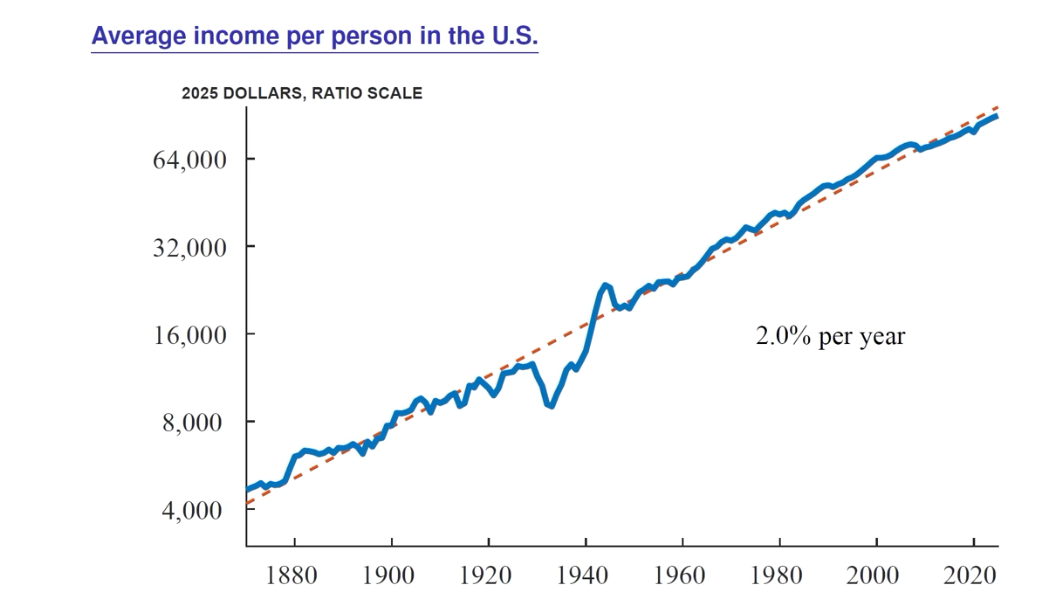
Despite the arrival of revolutionary technologies such as electricity, automobiles, semiconductors, and the internet, actual economic growth in the United States has averaged roughly 2% per year for more than a century. These technologies transformed society, but they did not dramatically accelerate long-term growth rates. AI, under this view, simply becomes the next technology that sustains growth rather than fundamentally changing its pace.
The Weak Link Principle
The most compelling idea from the talk was Acemoglu's concept of "weak links."
A chain is only as strong as its weakest link. Likewise, a business process is only as productive as its most limiting component.
A modern chip fabrication plant may involve thousands of highly automated processes, but a single critical failure can stop production. The Challenger disaster was famously traced to a small O-ring component. In both cases, success depended on every critical element functioning correctly.
The same logic applies to AI.
Even if AI automates 95% of a workflow, the remaining 5% may still determine overall productivity. Human judgment, coordination, problem formulation, regulatory approvals, physical infrastructure, or organizational processes can all become bottlenecks.
This helps explain why technology often transforms individual tasks much faster than it transforms entire industries.
Why Automation Doesn't Immediately Translate Into Growth
One interesting observation from the talk is that computers themselves account for only a small fraction of GDP despite becoming vastly more powerful over time.
Computing power has increased by millions of times over the past several decades, yet the share of economic output paid to computing equipment has actually declined since its peak around 2000. As computers become abundant and inexpensive, other scarce factors become the bottlenecks.
The lesson is that making one component dramatically better does not necessarily make the entire system dramatically better.
AI is likely to face the same challenge.
Automating all software engineering, for example, would primarily affect only the portion of GDP tied directly to software engineering (currently, this stands only at 2% of global GDP). The broader economy only benefits once complementary activities are transformed as well.
What Happens to Jobs?
Jones reminds us that jobs are bundles of tasks rather than single activities.
Radiology is an often quoted useful example. For years, experts predicted that AI would eliminate radiologists. Instead, the profession has grown, and radiologists continue to command high salaries. AI has automated certain tasks while increasing productivity and demand for other aspects of the job.
This does not mean all occupations are safe. Some jobs, particularly those involving repetitive and highly structured tasks, face substantial automation pressure. But history suggests that adoption and displacement often occur more slowly than expected.
The experience of self-driving cars is also instructive. Two decades after early predictions of imminent autonomy, deployment remains gradual and highly localized.
One of the more thought-provoking sections of the talk focused on how AI could affect the long-standing balance between income earned by labor and income earned by capital. Through a series of simulations, Jones examined how the share of GDP paid to workers versus owners of capital might evolve under different AI futures.
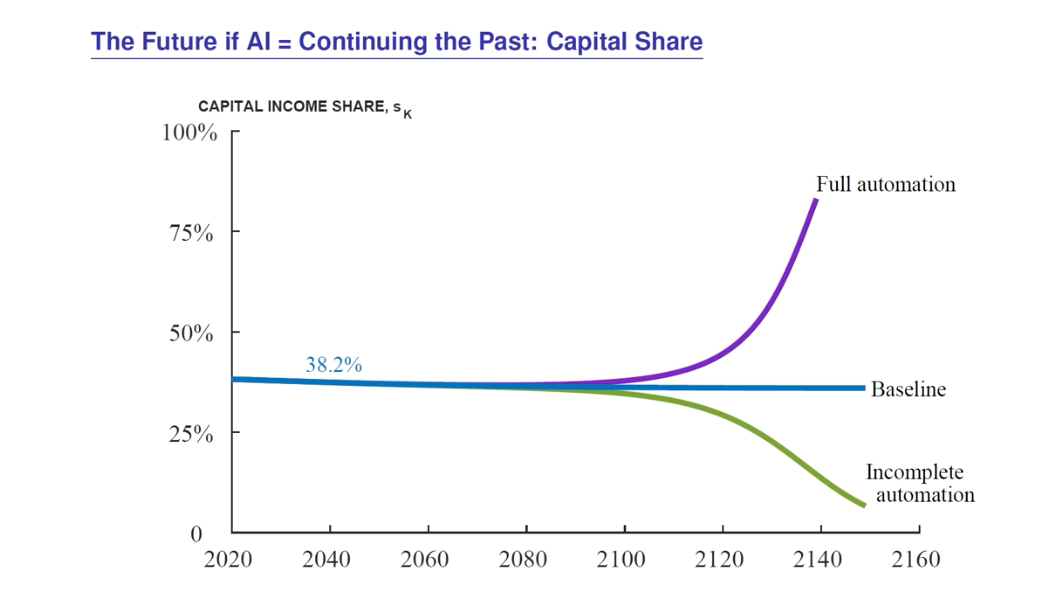
Historically, the split has been remarkably stable: roughly two-thirds of GDP has gone to labor and one-third to capital for much of modern economic history. In Jones's baseline scenario, this relationship remains largely intact. Even as AI drives higher productivity and economic growth, the share of income flowing to capital rises only modestly, reaching about 38% over the next eighty years before stabilizing.
The more dramatic outcomes emerge in the alternative scenarios. In the "purple" scenario, AI eventually automates all economically valuable tasks, leaving nothing uniquely human. Under these assumptions, the share of GDP paid to capital steadily rises toward 100%, while labor's share falls toward zero. Economic growth becomes extraordinarily rapid, but humans are no longer essential participants in production. However, even in the most aggressive scenarios, the changes take place over several decades.
The "green" scenario explores a different possibility based on the concept of weak links. Here, AI successfully automates 97% of tasks, but the remaining 3% still require uniquely human capabilities. Because every production process ultimately depends on these human tasks, people remain the critical bottleneck in the economy. As a result, labor retains its importance and continues to capture most of the economic gains despite widespread automation.
The key takeaway is that the future distribution of wealth may depend less on how powerful AI becomes and more on whether there remain tasks that only humans can perform. If humans continue to occupy the economy's critical weak links, labor may remain valuable even in a highly automated world. If not, the balance of economic power could shift dramatically toward owners of capital.
A Future of Abundance?
The long-term picture according to Jones remains remarkably optimistic.
If AI eventually automates most productive activities, society could experience unprecedented abundance. Economic output could grow dramatically, creating the possibility of higher living standards across the board.
Whether those gains are broadly shared, however, depends less on technology and more on politics, institutions, ownership, and policy choices.
Who owns the AI systems? Who owns the capital? How are gains distributed?
These questions will prove as important as the technology itself.
Risks Along the Way
The talk also highlighted several risks that deserve serious immediate attention.
The first is misuse. Increasingly capable AI systems could be used to discover software vulnerabilities, design harmful biological agents, or attack critical infrastructure.
The second is the possibility of highly autonomous systems that exceed human understanding or control. These concerns are indeed difficult to dismiss given the pace of progress.
Interestingly, the weak-link principle applies here as well. Complex systems can fail because of a single overlooked vulnerability, meaning that AI may amplify both productivity and fragility.
The Long View
The central message of this talk is one of cautious optimism.
AI is likely to be more transformative than the internet and one of the most important technologies ever developed. But transformation should not be confused with immediacy.
Economic systems contain countless weak links, organizational bottlenecks, and complementary requirements that slow change. As a result, AI's effects are likely to unfold over decades rather than years.
The future may indeed be one of extraordinary abundance and automation. The challenge is recognizing that even revolutionary technologies must work their way through the complex realities of human institutions, organizations, and societies before their full impact is felt.
Reference reading: