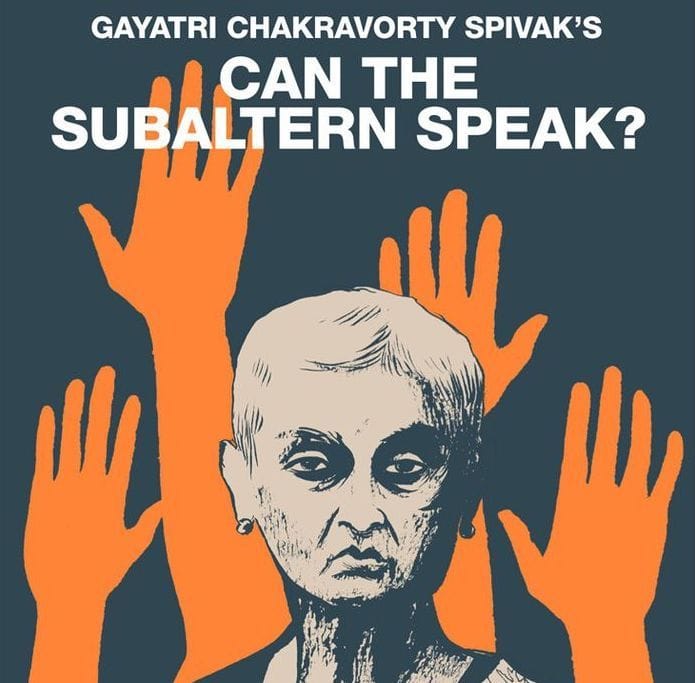
The essay "Can the Subaltern Speak?" (1988) by Gayatri Chakravorty Spivak, is an examination of the limitations and challenges faced by marginalized groups, particularly women, in representing themselves and having their voices heard within dominant discourses. Spivak focuses on the concept of the subaltern, a term referring to those who are socially and politically marginalized and silenced by dominant structures of power. Spivak questions whether it is possible for the subaltern to truly speak and be heard within the existing systems of power and knowledge. The subaltern's voice is often subsumed or co-opted by the dominant discourse, making it difficult for them to express their experiences and demands in their own terms. Furthermore, she examines the role of intellectuals and academics in representing the subaltern, highlighting the challenges of representing and speaking for others, raising concerns about the potential for reinforcing existing power structures and essentializing the experiences of the subaltern.
Spivak's scholarship has also been instrumental in advancing postcolonial theory, particularly through her critique of colonial and neocolonialist power structures. She has explored the ways in which knowledge production and representation have been used to reinforce colonial dominance. Her concept of "strategic essentialism" examines the strategic use of essentialist identities as a means of resisting oppression.
Spivak fondly draws on deconstructionist theories, particularly the work of Jacques Derrida, to analyze and deconstruct dominant discourses and texts. Her engagement with literary theory focuses on the politics of representation, the power dynamics involved in the production and interpretation of texts, and the role of language in shaping knowledge and identity.