The rose printed china cup was quite a favorite, but it came crashing down when my kid decided to play ball with it. I wasn’t around at home so I only got to hear about the incident amidst background chatter that never registered. Many months later I noticed something was amiss - I hadn’t seen it for eons. I was pretty sure my house had swallowed it, like all other things that had gone missing after baby came along. Socks, diaper wipes, pacifiers, keys, pens, soap bars, water bottles, caps, hairbands, handkerchiefs - these were the stuff of transient keep. I could never find them when I needed them. My kid or husband would misplace them, and I would forget to hunt them down, or I would keep them somewhere temporarily, and after attending to an urgent tantrum or earthquake (the two essentially being equivalent) forget to restore them to their designated spot.
And so I thought the cup went missing. Until I asked the nanny. She said she discovered it broken on the kitchen linoleum floor when she came home one morning.
 |
| Photo credit |
I said a prayer for the cup. I’d stopped stocking cups on a whim a while ago, but knew I could easily be cajoled into renewing the habit.
More recently, my travels to India and the Middle East saw me hanging around antique stores and sizing up bone china and porcelain at every opportunity to do so. Whether it was the Royal Doultons or Wedgewoods or a Bavarian cup or a floral silver goblet, I was hovering and hooked.
 |
| Photo credit |
One's fetish for cups and mugs is not to miss the craving for what is served in them. And so in the true jest of an international caffeine enthusiast, I compiled a list of my trials and waives. Tea or coffee, it is made and served in different ways across the world, each of which is worth pondering over, while pouring over.
Morrocan tea (Maghrebi)
 |
| Moroccan tea set : Photo credit |
Tea being central to social life in Morocco, most families own at least one full service tea set, with teapot (traditionally this can be directly put to boil on the gas), set of glasses and ornate trays. Made with Chinese gunpowder, fresh mint leaves, sugar and boiling water at the minimum, it can also be prepared with additional herbs like thyme, sage and lemon verbena.
 |
| Moroccan mint tea: Photo credit |
Argentinian tea
Argentina is a major tea cultivating nation, and its famous national drink yerba mate is known to have high anti-oxidant capacity as well as Vitamin B and C. It is considered healthier than green tea and aides in reducing cholesterol, blood pressure and strengthening the immune system.
 |
| Argentinian tea: Photo credit |
Cuban coffee (Cafe Cubano)
Whether or not you accompany it with a cigar, no cuban meal would be complete without it. Prepared as a shot of espresso this is strong coffee made sweet with a vigorously mixed froth of sugar that floats to the top like creme.
 |
| Cuban coffee: Photo credit |
Kenyan tea
Tea is a major cash crop in Kenya and one of its major exports. Kenyan black tea is internationally acclaimed for its special aroma and taste, often referred to as full bodied flavor.
 |
| Kenyan tea estate: Photo credit |
Japanese tea
There are many varieties of Japanese tea , the popular ones being Matcha(green tea made from plants grown in shade), Sencha (loose leaf green tea), Houjicha (roasted stems and leaves) etc. Japanese tea is often touted as being both healthy and tasty.
 |
| Japanese tea/garden: Photo credit |
Italian espresso
Italian espressos are a way of life. They are to be had standing at cafes or coffee bars, and as part of conversations, however quick and short. A well prepared espresso will not be bitter (only slightly), well bodied and aromatic.
 |
| Italian espresso: Photo credit |
Indian/Pakistani tea
 |
| Chai ceremony: Photo credit |
 |
| Masala chai: Photo credit |
India is a nation of tea drinkers. We both produce and consume it en masse. Your quintessential chai is a part of every morning and evening routine, offered to guests, had on the go, in the office or during breaks and intervals. I make mine with milk, cloves, cardamom, ground cinnamon, black pepper, ginger and sugar. It is best had in kulhads - earthen clay cups which impart an earthy aroma and taste, but can be found easily in anything from glasses (cutting chai) to porcelain tea cups.
 |
| Cutting chai : Photo credit |
Irish coffee
Irish coffee is a cocktail of hot and sweetened coffee, Irish whiskey and topped with thick whipped cream. Often had during celebrations and the holidays, on cold winter nights or even just after dinner.
 |
| Irish coffee: Photo credit |
Turkish tea
 |
| Turkish tea: Photo credit |
Turkish tea is extremely popular across Turkey and consumed through the day, is made in a traditional teapot (çaydanlık) that comes in two portions stacked up together. The bottom portion boils the water and the top contains the steeped tea. It is served in small curvy glasses with a small saucer underneath. My own Turkish tea set comes with with silver holders, a silver tray and a dish with an ornate lid, serving me well with a perennial reminder to visit Istanbul.
 |
| Turkish tea set: Photo credit |
Turkish coffee
 |
| Turkish coffee: Photo credit |
 |
| Photo credit |
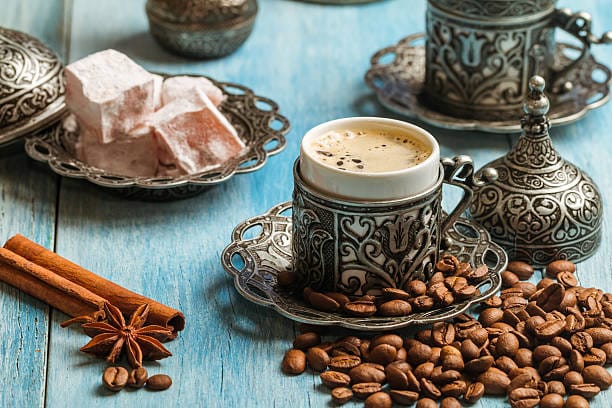
Made with very very finely ground coffee beans and boiling water mixed with sugar (prior to the boiling) and prepared in a cezve (pot made of copper), this became a personal favorite during my Qatar trip, consumed almost every other day at the Souq. You will need to specify the level of sugar beforehand, I usually go with moderate. A fun fact with coffee in Turkish tradition is that often a bride-to-be puts salt in her fiance’s coffee, to ‘test’ him. If he continues to drink it without any signs of displeasure or complaint it is assumed that he will be a patient and good-natured husband.
 |
| Turkish coffee: Photo credit |
Denmark Kaffee
 |
| Cafe in Denmark: Photo credit |
Denmark ranks among the highest coffee consuming nations in the world, probably due to the cold, dark Nordic winters.
 |
| Denmark Kaffee: Photo credit |
Arabian Kahwa
 |
| Arabian Kahwa: Photo credit |
Often spiced up with cardamom and dates (as opposed to sugar), coffee is pivotal to Arab social life, and is considered a symbol of hospitality, generosity and sophistication. Marriages, trade contracts and even wars and blood feuds are settled over a dallah full of stimulating Kahwa. Thankfully I enjoyed mine without the formidable seriousness of the aforementioned agendas.
 |
| Arabic coffee: Photo credit |
Greek frappe
 |
| Greek Frappe: Photo credit |
Mix instant coffee in a shaker with water and sugar, plug it in with ice cubes and milk, and you have a frappe. Often served with a foam in a tall glass and a straw it is one of the most popular drinks in Greece.
 |
| Greek Frappe: Photo credit |
Mexican caffe de ola
Made with water, cinnamon and brown sugar (Piloncillo) and ground coffee, this needs to be sipped in an earthen pot to bring out its true taste. Mexican spiced chocolate mocha is also a close relative that can be pampered into a favored indulgence during winter months.
 |
| Mexican coffee: Photo credit |
New Zealand tea
 |
| Photo credit |
Before coffee took over the Kiwis, tea used to be the preferred drink. New Zealand has its own version of high tea with delicate sandwiches, sweet treats, scones, cream cakes and a pot of hot tea served late in the afternoon or early evening.
 |
| New Zealand high tea: Photo credit |
Russian tea
 |
| Russian tea: Photo credit |
Russian tea preparation consists of a two step brewing process. The first being where the tea concentrate zavarka is brewed in a small metal teapot named samovar. Following this, the tea is served in small quantities in mugs, and you can dilute it with boiling water in small or large quantities according to your taste. Tea is almost never served without accompaniments like biscuits, sweets, cakes, jams, lemons etc.
 |
| Tea ceremony, Russia: Photo credit |
Chinese tea
 |
| Chinese tea: Photo credit |
The Chinese have a long history of drinking tea since tea originated there. They drink it through the day like water.
 |
| Chinese tea: Photo credit |
Ethiopan coffee (buna)
 |
| Ethiopian coffee: Photo credit |
Coffee is said to have originated in Ethiopia, is wildly grown there and has varied and distinctive flavors, from winey to fruity. I almost never pass a chance to taste Ethiopian coffee at a specialty cafe in San Francisco or a farmer's market in the Bay Area.
 |
| Ethiopian coffee: Photo credit |
Austrian melange
Similar to an Italian cappuccino, its usually an espresso at the base, topped with whipped cream instead of foamed milk.
 |
| Austrian melange: Photo credit |
Thai (iced) tea
 |
| Thai iced tea: Photo credit |
Summer in New York! The perfect companion to a spicy hot Thai meal, Thai iced tea is prepared with black tea , spices, sugar, condensed milk and colors rendering it the orange/amber tone.
 |
| Thai iced tea: Photo credit |
English tea
Tea in England popularised in the 17th century, the tradition of afternoon ‘high’ tea gained currency in the second half of the 19th century as a fashionable social event. Tea is almost always had with milk and sugar.
 |
| English tea: Photo credit |
Iranian tea
 |
| Persian tea: Photo credit |
Persians drink tea in the morning, after meals and throughout the day. They use glass cups to drink tea and it allows them to gauge consistency and color. The persian way to drink tea is to pour the tea into the glass teacup, check out the color meanwhile allowing the glass to warm up. Then the host pours it back into the teapot to heat up more or allow it to steep more in case the tea is light. Finally the tea is poured back up to a third of the cup’s capacity.
 |
| Iranian tea: Photo credit |
South Indian filter coffee
 |
| Filter coffee: Photo credit |
Feels like home! I personally make mine from Cotha's coffee powder, an old south Indian brand. Using a coffee filter, place the coffee powder in the upper funnel, filling it with water, allowing the coffee to go through a slow blooming cycle. Meanwhile, heat the milk to a boiling point and when the coffee drips, add the uber hot milk on top. Serve in a traditional dabara set, adding desired amount of sugar to taste and pouring the mixture back and forth between the dabara and tumbler to allow cooling, mixing and additional frothiness.
 |
| South Indian filter coffee: Photo credit |