The Great Star Theatre in San Francisco is tucked away in a hidden alley in the historic Chinatown district, and is almost as old as the district itself. It is regarded as the last of its kind in America - a theatre that airs Chinese language films and opera as well as films from Hong Kong from the early 1920s. While the imported allure of San Francisco’s Chinatown can be as enticing to an insider as to an outsider or immigrant, the theatre’s grungy interior , thick heavy red curtained stage and padded seating - akin to an aging version of a traditional Off Broadway venue - is poised to take you as far back in time. Or ahead of it, as with the screening of a certain off-beat performance I happened to catch last summer - one Circus Automatic’s ‘In the Tree of Smoke’ - a low budget strung together production advertised as “whose end goal is to create a fully realized production in the face of a lack of resources”. Turns out they did more than just that.
The show was an amalgamation of disjoint techno videos and musical overlays from independent musicians and lecturers, mostly provided as a conjunction to the various original enactments of its circus actors. Most of these acts are again performed against a series of pre-existing music and prose. In its holistic entirety though it takes on another kind of art form that abstracts and distinctly characterizes itself as an experiment of thought and movement.
My own relationship with experimental art has been steadily consistent and uncomplicated - I tend to either love it or hate it. Here, love it was that won the day.
One of the earliest scenes is against a backdrop of Simon Christen’s nouveau art video Adrift capturing San Francisco’s fog city. Superimposed upon it is Terence Mckenna’s lecture on 'Linear Societies and Non-linear drugs'. Mckenna who was one of the leading pioneers of the psychedelic drugs movement narrates in controlled monotone:
“The thing that I’m coming to from my psychedelic experience and my life experience and the whole ball of wax, is, I said for many many years that the world is made of language…. but that there’s more to it than that. It’s that everything is code. Everything is code in the sense that hackers mean when they say that they write code...He initiates you into a code, a vocabulary with very defined rules and quick to learn, and then they are like tinker toys, once you know the rules of the connectivity then you can sit down like a child and begin to stick these things together, well what would this be like, and what would this be like, and does god allow this or does this break the rules and so forth. The DNA is like that. Human language is like that. Human body language is like that. Machines communicate like this; in fact, this is a bridge which connects us. This is the great overarching bridge which will connect us to the machines, that they like us are commanded by language...
And so this realization that everything is code and code is moving on many levels is I think, more primary than the perception for example that things are made of space time matter and energy that’s one level below code. The code codes for space, time, matter and energy. It’s much more like we’re in a simulacrum, some kind of machine environment and in fact I like that idea because I’ve always sensed, and psychedelics have always intensified this intuition in me, that the universe is a puzzle, life is a problem to be solved, it’s a conundrum, it’s not what it appears to be there are doors, there are locks and keys, there are levels, and if you get it right somehow it will give way to something extremely unexpected.”
Arcane or cryptic as the narration sounds, it had a soothing and harmonical aesthetic to it .
The performances of the various circus artists were interspersed in parts with video montage breaks and video-sound mixing techniques, including an interval with a stirring tribute to the Bladerunner - as informing of the distant emotive horizons that movie magic attempts at creating as the very real achievement of the performers themselves. The retro-theme of the Bladerunner - a generation-old flick of the future - is a choice with special character. It pulls you back in time because its so old, and yet forward into the distant intergalactic future by its thematic current. Likewise, the inter-mangled themes of high-tech and creative art constantly in play throughout the performances stretch in parallel dimensions, sometimes opposed in their outreach - science is pervasive, whereas art is known only to those who seek it, and sometimes harmonious, when it is celebrated by the electro-beat music and the limitless modernity of the circus enactments.
Another memorable intermission clip was a Neil deGrasse Tyson video on ‘We stopped dreaming’ - “Space enthusiasts say, 'Oh, we're on the moon in '69, we'll be on Mars in another ten years.' They completely did not understand why we got to the moon in the first place: we were at war. “ ...“Do you realize that the $850 billion bank bailout -- that sum of money -- is greater than the entire fifty-year running budget of NASA?" Neil de Grasse suggests in the stirring video that the focus on commercial gains advocated by Congress decisions to cater to the rich elements of society run in opposition to a scantily regarded and poorly funded NASA space program - which according to him is the kind of technological endeavor worth dreaming about, since it empowers the ideas of tomorrow - “the homes of tomorrow, the city of tomorrow, the transportation of tomorrow”.
The show’s San Francisco focus is an underlying base theme. This is hard to miss, yet conveyed overtly only in the attire, mannerisms, motifs and spirit of the performers. The evolution of the minimalistic set to a sum much more than its parts is a signature of the creative endeavors San Francisco has ingrained in its DNA. According to the official statements, “Circus Automatic’s aim is to bring disparate audiences together for a show that achieves highly structured performance and at the same time an immersive environment more akin to the experiential reality of clubs, carnival and city streets. We dream of a floating world". The clubs, carnival and city streets that the circus aim to identify and showcase is none other than San Francisco itself, an old San Francisco that has seen upheaval , metamorphosis, evictions and transformation in the past couple of years at such an astounding pace that there are parts of the city one can no longer recognize for what they used to be. The production posits itself as a ‘swan song to a San Francisco that no longer exists’ and suggests the query ‘is there space for art in a world that no longer deems it relevant?’ A world where the commercial success of a wealth creation machinery is juxtaposed against the minimalist production set, the rigorous talent of artisans who are masters of their craft but possess neither the budget or the capacity for mass outreach, marketing or any herculean commercial effort - is presented for you to judge.
The initial acts comprise Katie Scarlet’s silhouetted dance performance against the acute electric guitar of a sharp and inventive John Zorn recording. Followed by Fleeky Flanco’s entry on stage on a shopping cart base, achieving all sorts of contortionist gymnastics as this master of frontbending amazes you with the various techniques that can be employed to squeeze a human body through funnels, barrels and orbs. “Better Use of Leisure time” featuring Chloe Axelrod takes you to a retro time space continuum where a 1950’s coronet instructional video makes way to an enchanting circus act by Chloe while she experiments performing on her chair. The switch from the dated video to the contemporary music of Santogold’s ‘Icarus’ is electrifying and titillating. I later compared it with Arthur Russell’s ‘This is How we walk on the moon’ and discovered the background cello which is essentially the same across both songs has a unique steaminess to it, that was accentuated by Chloe’s intense aerial gymnastics. The act was followed by the brilliant Inka Seifker, whose hand stand allowed her to shoot an arrow from a bow held at her feet. Inka is no stranger to strange modes. Having set the Guinness World record for “Farthest arrow shot into a target with her feet” she arrests you with her easy charm while she’s at it, or even when she contorts her body into the most mind-boggling octopus configurations.
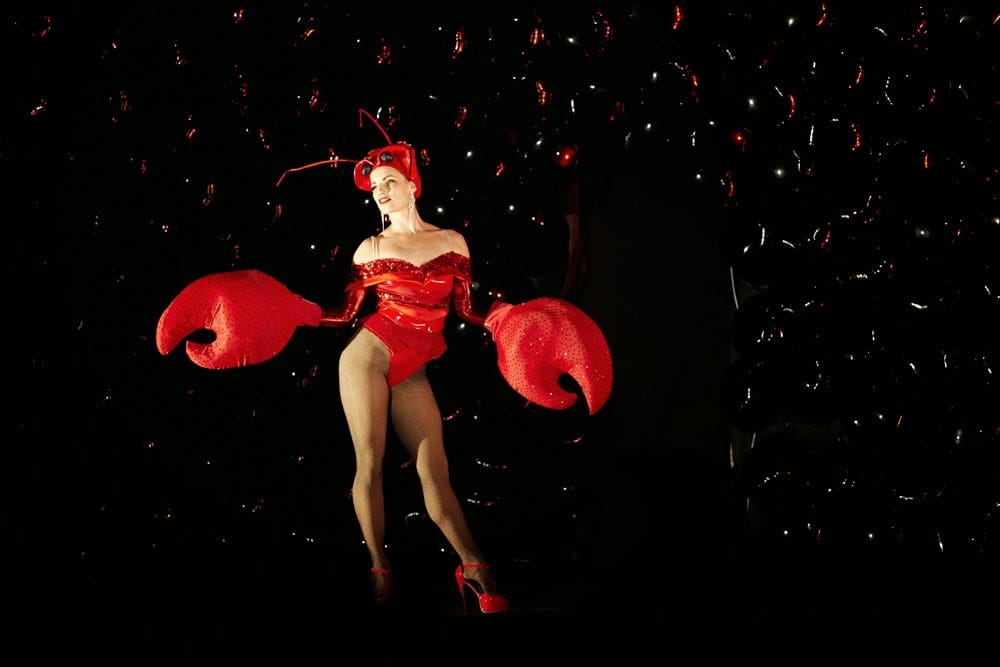
In Act two, Micah Walters engaged in impressive acrobatics and Katie Scarlet in a most superlative aerialist dance named 'Dreams Like Blood' swinging to the intoxicating tune of the Chromatics - 'The River' on satin cloth trampolines. A divergent and somewhat stationary but nonetheless captivating act was performed by Bree Rock in 'Crawfishing in America' when she sang a languorous, haunting and slow ‘Sunday Morning’ in a lobster costume. Rock, who is the first born daughter of a convicted bank robber , is said to have an appreciation for the dramatic and unusual, which was cultivated at a very young age.
We get to see Fleeky Flanco yet again in a third act of hand balancing while exhibiting staccato body movements to the background rhythm in an inverted position, and also later a most astute balancing feat on two longitudinally positioned pile of bricks. The grand finale is a spinning ring dance by the beautiful Chloe Axelrod - who can spin faster than you have probably ever seen before. The music was the icing on the cake for this act - a smooth blend of the score and the aerial dance lent a synergy greater than the sum of the two.
Overall, a magnetic experiment that aspired to a unique potential for greatness, a place to reinstate the professional rigor of these virtuoso artists and a sophisticated medium of expression of a city with a fast changing face and dynamic. I look forward to keeping up with what Circus Automatic has in store for the future.