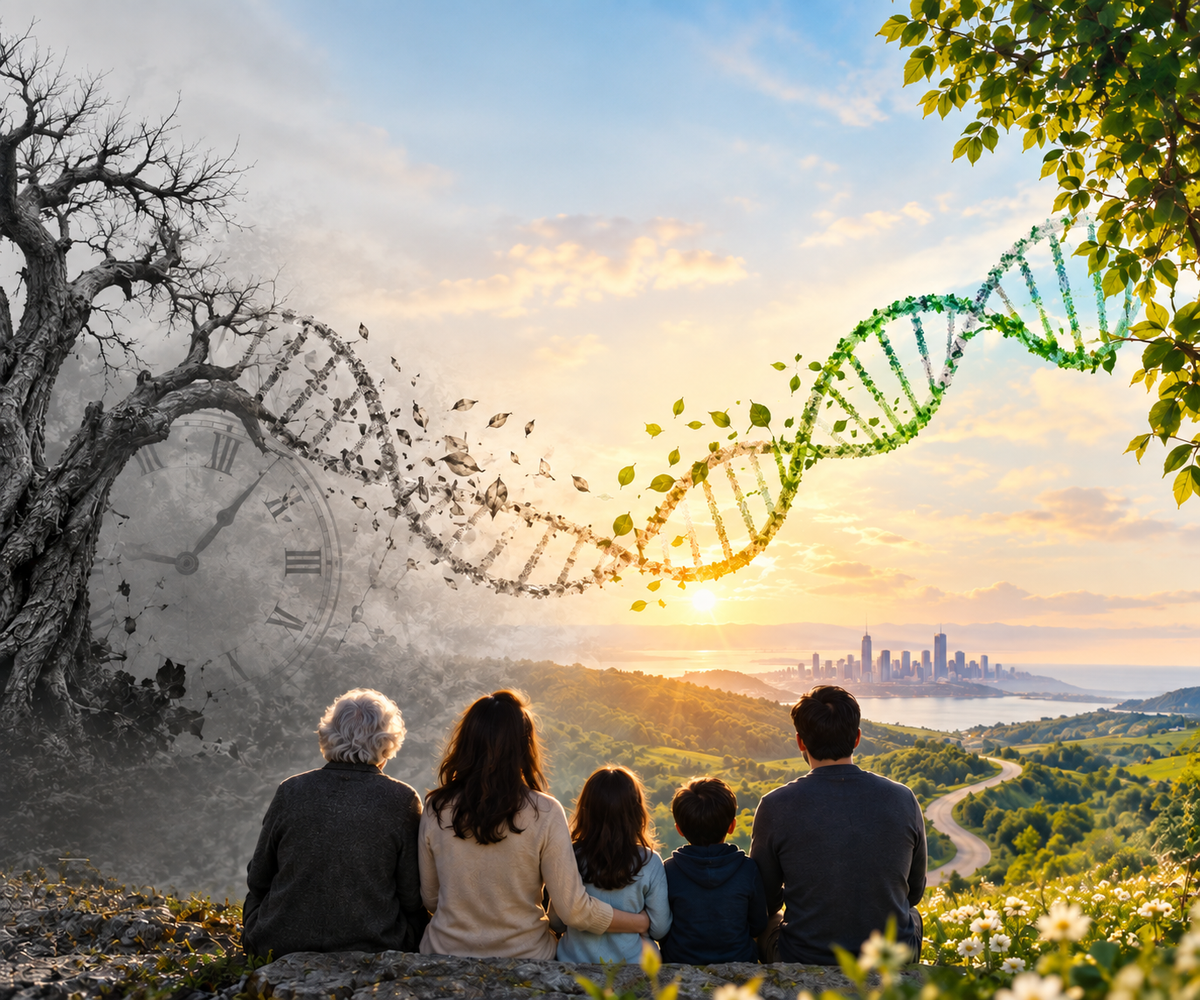
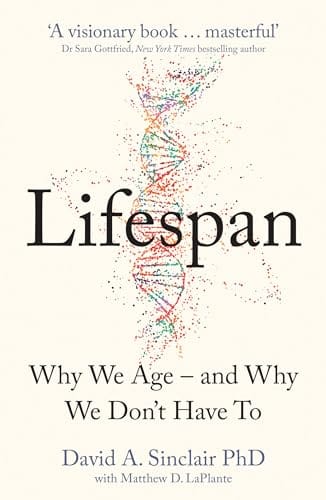
I recently read David Sinclair's Lifespan: Why We Age—and Why We Don't Have To, and found it to be one of the more revealing books I have read in some time.
The central proposition is bold: aging is not simply an inevitable process of wearing out. It is, at least partly, a biological process that we may eventually learn to manipulate. Sinclair describes aging through what he calls the "Information Theory of Aging"- the idea that cells progressively lose the epigenetic information that tells them which genes to turn on and off and, in effect, how to remain themselves. If that information can somehow be preserved or restored, perhaps some aspects of aging can be slowed - or even reversed.
While we are currently witnessing the age of Artificial Intelligence as technology’s latest frontier, I wonder if biology may turn out to be the next - and one wherein we allow it to fundamentally alter ourselves.
From treating disease to treating aging
Lifespan threads the concept that modern medicine largely waits for something to go wrong. For instance, we develop cardiovascular disease and treat it. We develop cancer and attack it. Bones deteriorate, neurons die, metabolism changes and organs fail - and medicine develops increasingly sophisticated interventions for each problem. However, Geroscience proposes a different question: what if many of these diseases share an upstream common cause - aging itself?
So instead of fighting individual fires, could medicine eventually intervene in the biological processes that make all those fires increasingly likely?
Sinclair discusses several pathways that researchers have explored: sirtuins, NAD metabolism, mTOR, cellular senescence, DNA damage and epigenetic change. He also speculates about interventions ranging from fasting and exercise to drugs and, ultimately, cellular reprogramming.
Despite very compelling experimental evidence supporting increasing lifespans, some of the book's optimism needs to be treated cautiously. Lifespan was published in 2019, and seven years later, of course, we still do not have a therapy demonstrated to meaningfully reverse human aging. Results in mice that were demonstrated in the book are much easier to produce than safe, durable rejuvenation in humans.
Meanwhile, progress is being made. Sinclair and colleagues have subsequently formalized the Information Theory of Aging, arguing that loss of epigenetic information may be an important driver of aging and that reprogramming cells could potentially restore aspects of youthful function. Partial cellular reprogramming has produced intriguing rejuvenating effects in animal and cellular models, although cancer risk, loss of cellular identity and safe delivery remain formidable obstacles. Meanwhile, senolytics - drugs designed to eliminate dysfunctional senescent cells- have moved into early human trials, though researchers emphasize that convincing evidence of clinical benefit in humans is still lacking.
Rapamycin, another much-discussed longevity candidate, has now been studied in a randomized year-long trial in healthy adults, with some encouraging signals but nothing resembling proof that we have actually discovered a human longevity drug. And enthusiasm around metformin has become more tempered as subsequent studies have questioned some of the earlier evidence for anti-aging effects in healthy people.
The bottlenecks
Measuring aging
Before we can reverse aging, we need to know what biological age really means.
Epigenetic clocks can estimate age from patterns of DNA methylation, and newer clocks attempt to predict health and mortality rather than birthdays. But lowering a biomarker is not necessarily the same thing as making someone younger.
If a treatment makes your epigenetic clock five years younger but doesn't reduce cancer, dementia, frailty or mortality, what exactly has been rejuvenated?
Recent reviews of human intervention studies underscore this problem: different biological clocks respond differently to interventions, and several much-hyped longevity compounds have not reliably moved newer-generation clocks.
A credible longevity revolution will thus require validated biomarkers that regulators and doctors can trust.
Can we rejuvenate cells without causing cancer?
This may be one of the hardest problems to solve.
Some mechanisms that make cells young are precisely the mechanisms that allow them to grow and divide. And cancer exploits many of those same capabilities.
Partial epigenetic reprogramming is interesting because researchers are attempting to reset aspects of cellular age without taking cells all the way back to an embryonic state. Animal experiments suggest that this is possible. But controlling the degree, timing and location of reprogramming is critical; go too far and cells can lose their identities or potentially become tumorigenic.
Can we solve all the different causes of aging at once?
Aging increasingly looks less like a single switch and more like an interconnected system: genomic instability, epigenetic alterations, mitochondrial dysfunction, cellular senescence, chronic inflammation, stem-cell exhaustion and other processes reinforce one another.
Fixing one aspect may not fix the interconnected system.
Intriguingly, a 2026 theoretical study looked at just one of these constraints-somatic mutations accumulating in our cells - and estimated that even eliminating every other hallmark of aging would still leave mutation accumulation as a substantial eventual limit. That doesn't tell us how long humans will live, but it illustrates that longevity may ultimately require multiple interventions working together rather than one miracle molecule.
Perhaps future longevity medicine will look less like taking a statin and more like maintaining an aircraft: periodic senescent-cell clearance, immune rejuvenation, epigenetic resetting, tissue regeneration, cancer surveillance and eventually replacement or repair of damaged organs.
How do we prove that any of this works?
There is also an almost comical problem with longevity trials: humans live too long.
If we give a healthy 50-year-old a treatment intended to add twenty healthy years to her life, waiting thirty years to determine whether it worked is hardly a practical drug-development strategy.
Regulatory systems were designed around diseases with measurable endpoints, and not "aging."
Aging itself is still not an FDA-approved indication. Researchers therefore need accepted surrogate endpoints or trials demonstrating that an intervention simultaneously delays several age-related diseases.
Without solving this regulatory and measurement problem, potentially useful therapies could remain stuck between promising biology and clinical medicine.
Who gets the extra years?
This may eventually become the larger problem than the science. The social implications are real and daunting.
Suppose rejuvenation treatments work, but initially cost $500,000.
Do we create a world in which wealthy people live significantly longer than everyone else?
What happens to retirement at 65 if healthy life expectancy becomes 110? Do people have three careers? When do they inherit wealth? What happens to pensions, housing, population growth and intergenerational mobility?
Profoundly, does a longer life make us as humans more ambitious , or more cautious?
Our institutions are built around a roughly predictable human lifecycle: education, work, family, retirement and death. Radical longevity would not merely change medicine. It would force us to redesign that lifecycle. I almost believe it has the potential to create the kind of upheaval we are witnessing today with AI at the forefront.
That said, as of today its obvious that demographers looking at actual mortality data find little evidence that radical life extension has begun. A major Nature Aging analysis concluded that increases in life expectancy have actually slowed in the world's longest-lived populations since 1990. Without genuine interventions in biological aging, the authors argue, radical extension of human lifespan this century is unlikely.
And yet, demography just tells us what happens without a fundamental technological discontinuity. The Geroscience as per the book, is asking whether such a discontinuity can be created.
Perhaps a more reasonable conjecture may be that the first revolution will therefore not be immortality- or even people routinely living to 150.
It will be healthspan.
Imagine being 80 with the cardiovascular health, muscle strength, immune function and cognitive ability that we currently associate with someone decades younger. Moving the period of frailty and chronic disease from the final twenty years of life into the final five would itself be an extraordinary achievement, even if maximum lifespan barely changed.
AI can accelerate progress, surely. AI can accelerate drug discovery, protein design, biological simulation and personalized medicine. Better biomarkers could make experiments dramatically faster. Gene and cell therapies could allow increasingly precise repair. Regenerative medicine may eventually replace tissues that cannot be rejuvenated. So at some point these technologies may begin reinforcing one another.
In summary, while the technological progress needs to be made, several themes come to mind to tackle this materially and holistically:
Can we understand the enormously complex biological system that evolution has produced well enough to repair it while it is still running?
Can we extend life without merely extending old age?
Can we make those extra years accessible rather than creating the ultimate form of inequality?
And if someday we succeed, are our societies - and perhaps even our own sense of what constitutes a meaningful life - prepared for the consequences?