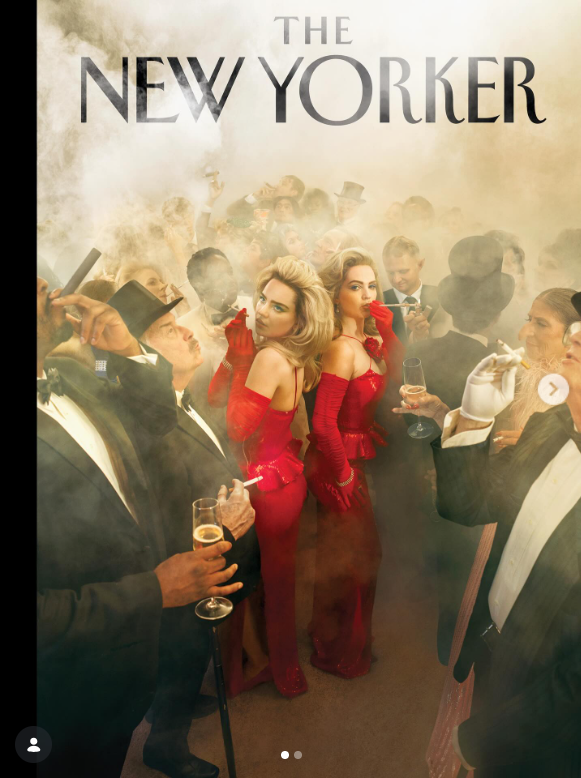
Recently I came across two New Yorker covers that are more directly connected than they first appear. The first is Julian de Miskey’s cover for the October 18, 1930 issue of The New Yorker. The second is a deliberate 2025 reinterpretation of that very cover, photographed by Alex Prager with identical twins Sophie and Ellie Thatcher at the center. It was part of The New Yorker’s centennial project, in which six contemporary photographers were asked to reimagine memorable illustrated covers from the magazine’s first hundred years using live photography.
De Miskey’s original captures a glamorous, smoke-filled New York soirée: tuxedos, top hats, evening gowns, pearls, cigarettes and cigars. The exaggerated faces, elongated bodies and almost absurd concentration of fashionable people give it the characteristic observational humor of the early New Yorker, a style seen many times over even in more recent versions of the magazine. Everyone is dressed to be seen, yet almost no one seems genuinely engaged with anyone else. They occupy the same crowded room while looking upward, sideways or past one another. Though typical of later New Yorker cover styles, the image taken in itself seems to turn upscale Manhattan nightlife into a kind of social theatre.
That attitude was central to the young magazine's identity. The New Yorker had been founded only five years earlier and was cultivating a sophisticated but irreverent way of looking at metropolitan life. Its early visual culture frequently portrayed a world of confidence, gaiety, and urbane society while simultaneously poking fun at its affectations.
Prager's contemporary version preserves almost all of the visual vocabulary - formal clothes, cigarettes and cigars, haze, champagne, black top hats, and the striking women in red at the center. But illustration has become photography, caricature has become carefully staged human performance, and the anonymous illustrated women have become the real-life twins Sophie and Ellie Thatcher.
It is interesting that Prager did not attempt a literal copy. The contemporary image is cinematic and self-conscious. The central women stare directly at us, while the surrounding partygoers seem absorbed in their own performances. The smoke is theatrical; the clothes are exaggerated; the whole scene feels simultaneously real and artificial. It preserves the social spectacle of the original while making us much more conscious that the glamour is constructed. While the 1930 illustration abstracted New York society into a caricature, the 2025 take by Prager converted it back into real people under the guise of an artificial drawing.