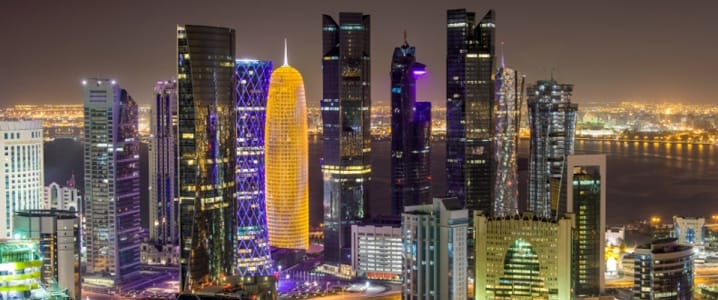
This month's crisis among the affluent Arab Gulf monarchies with Saudi Arabia, UAE and Bahrain pitting a tough embargo against Qatar has shaken up political equations in the Middle East, promising an escalation of turbulence and demanding a policy realignment in the region. First with the land and air sanctions and restrictions on food and medicines, and later followed by a 13 point ultimatum of overwhelming, almost impossible to achieve statutes in the span of 10 days , the kind of belligerence that is meted out against Qatar bodes of darker days ahead for the region as a whole.
Amar Diwaker in the Boston Globe unravels the power politics behind the rift against Qatar:
"By charging Qatar with an ancillary role in supporting terror networks, the Saudi-UAE axis intends to procure the legitimacy necessary to eliminate a pesky barrier in the path toward confronting their most potent rivals in the region: the Muslim Brotherhood and Iran.
A population south of three million, Qatar punches above its weight: having effectively converted financial clout derived from vast gas reserves to chart an independent foreign policy. Its media platform, Al Jazeera, has been the lynchpin of its soft power projection on the international stage, and a thorn in the side of the Saudis. Over the past decade, it became a prominent mediator in a number of regional conflicts, and its enthusiastic backing for the Muslim Brotherhood was rooted in a calculus that anticipated it as a burgeoning political force."At the center of the storm lies the nervous future of Al Jazeera, considered by many as a beacon of fresh, uncensored journalism giving voice to many in the Middle East, even when its companion Arabic channel has suffered tarnished reviews due to some incendiary reporting.Greg Carlston of the Atlantic meditates:
 |
| Fig 2 |
"Founded in 1996, Al Jazeera quickly rose to prominence by offering a medium for freewheeling debate and criticism of the region’s aging, authoritarian rulers. The one exception, of course, was reporting on Qatar itself, where the network took a noticeably light touch. In 1999, when the longtime Egyptian president Hosni Mubarak visited its cramped studios, he was said to remark, “all that noise from this matchbox?”Despite the headaches it caused, Al Jazeera’s Arabic channel (AJA) was a useful instrument of soft power for a tiny state that once tried to stand apart from both its neighbors and the region’s internecine feuds. Doha used to be a sort of Geneva-on-the-Gulf, the place where everyone went to hash out their differences. It wasn't uncommon to see camouflage-clad Sudanese rebels taking high tea in the lobby of the Four Seasons. Hamas and Fatah, the rival Palestinian factions, signed a reconciliation deal in Qatar. Lebanese leaders did the same in 2008, ending an 18-month standoff in Beirut."Whatever spin the current crisis takes in the near run, the longer term repercussions are likely to be negative given the deep nature of the underlying conflicts between the various parties involved. Not least is an antagonism between the various states on what kind of political Islam each should espouse as part of their foreign polity and ideology. The tussle to control and curb has long been in the works, now resulting in clear distinctions in the way the Saudi-UAE nexus and Qatar-Turkey alignments have taken form.
More on this from The Washington Post:
"Qatar bet on the rise of the Muslim Brotherhood throughout the Arab world long before the Arab Spring, providing support for Brotherhood groups in the region; safe haven for Brotherhood exiles like the Egyptian preacher Yusuf al-Qaradawi and Hamas leader Khaled Mashal; and a platform for populist and electoral Sunni Islamist views in the regional satellite channels of the Al Jazeera network.
 |
| Fig 3 |
This populist Sunni Islamist stance, while certainly not liberal democratic, seeks power through electoral means. This vision was shared by Turkish President Recep Tayyip Erdogan, who saw in the Muslim Brotherhood’s successes after the Arab Spring the possibility of a bloc of similar regimes, with Turkey at its head.Saudi Arabia represents the antithesis of populist, bottom-up Sunni Islam. The monarchy long ago made its Salafi religious establishment, known as Wahhabi, a partner in supporting its rule.The Saudi men of religion are now state bureaucrats, advocating a puritanical and xenophobic social interpretation of Islam and endeavoring to spread that interpretation throughout the Muslim world by loyally supporting the monarchy and by counseling that it is the duty of good Muslims to obey the rulers. This is top-down, not bottom-up, political Islam.The United Arab Emirates, while allied with Saudi Arabia, represents a third trend in political Islam. Official Islam in the Emirates is tightly tied to state authority and subservient to it. Unlike in Saudi Arabia, the Emiratis have no ambition to propagate Islam beyond their borders. Just the opposite — they support anti-Islamist forces in Egypt, Libya and elsewhere. This is top-down Islam, but in one country.In this they are joined by Egypt, once the center of Arab politics, but now, given its domestic economic and political problems, more a follower than a leader. The great center of Sunni Islamic learning in Cairo, al-Azhar, certainly has ambitions beyond Egypt’s borders. But it does not have the financial capacity to challenge the Saudi-funded institutions of global Salafi Islam.Add in the Salafi Islamist militant position represented by the Islamic State and al-Qaeda, and the ideological conflicts within the Sunni world become even more fraught. They share the puritanical Salafi interpretation of Islam with Saudi Arabia but hate the Saudi rulers as sellouts to the United States.They are a bottom-up, populist movement but reject the electoral course taken by Erdogan’s party and the Muslim Brotherhood. State Islam within the existing regional borders is the antithesis of their message of a united Muslim community. The Islamic State and al-Qaeda have attacked the Turkish, Saudi and Egyptian regimes on numerous occasions."
More here