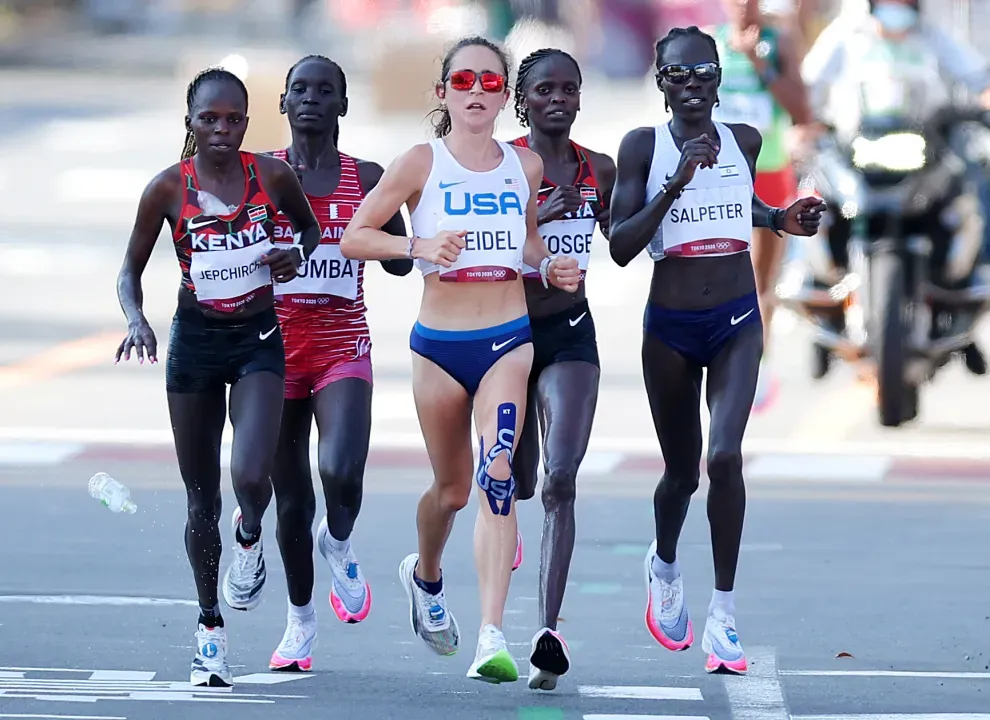
We are different, in essence, from other men. If you want to win something, run 100 meters. If you want to experience something, run a marathon. - Emil Zatopek (Czech marathoner)
"30 seconds guys, 30 seconds...", says Tony.
Already? I've barely caught my breath back from finishing the last 5 rounds in the nth set of loops around Kezar stadium. I better BREATHE...stretch...calf stretch..quad stretch...hamstring stretch...gaasp..before we hit the road again.
"15 seconds guys, 15 seconds...", murmurs Tony pensively.
I'm beginning to think maybe I can really walk in a straight line now....
"5..4..3..2..1. go go GO!"
"How many loops?" , I ask.
"Six..just six"

Splat. No point complaining. I need to start real slow now so that I can finish this run without having to walk or stop. And I need to stop thinking that I'm running, and not count the distance till later, so that I can trick my mind into believing that I'm really just stroll-jogging. 'Running is something I can do by myself, under my own power, as fast or as slow as I want', I begin to think to myself smugly, satisfied with the strategy. Suddenly a pack of swanky bodies breezes by. I look at them gliding ahead - their toned muscles tightened and strapped as their feet hit the ground, and beads of sweat glistening their baroque necks, running down in rivets. I can't see their faces anymore but imagine they'd be nothing short of a vigorous hawkish expression. Swashbuckling. Oh, to be those athletes in training. The vision was enough to make me pick up my pace. To an innocent bystander, it would ordinarily have invoked, like it did in me, many months ago, the overpowering feeling of awe - enough to toss that bag of greasy fries into the trash bin and make the resolution : I must run a marathon.
I reach the end of the race, towards the crowd of other Asha runners who have already finished, slowing down and stepping to the side of the track. Phew, time for respite till the sunday 12-mile long run! "18 minutes 27 seconds", says Tony, squinting at his stopwatch against the force of the sun's rays. "Good", he nods.
Coach Tony has completed more than 50 marathons over the past 15 years. He's been running in the Boston marathon for several years and has finished previously in around two and a half hours.(Considered the most arduous to qualify for, the Boston Marathon is the world's oldest annual marathon, inspired by the success of the first 1896 Olympic marathon).These days he's wrought up staying awake to cater to his 3-month old baby, and I think he probably runs marathons between babysitting sessions.

I go home and surf through emails, and come across one by Stanley who's been running the Vineman Ironman : 2.4 miles of swimming, 112 miles of biking, and 26.2 miles of running - in that sequence. Also, I recollect one by Rajeev to the team recently - he's been running the 250 mile Thames Ring Ultra (unaided with no food/fuel provided, and requiring completion within 100 hours). Most ultramarathons, especially trail challenges, have severe course obstacles, such as rugged terrain or inclement weather . I've also recently learnt about races which are 1000 miles and longer(multi-day, of course), that people actually participate in. Many of these races are run on dirt roads or mountain paths, though some are run on paved roads as well. Astonishing as it is, more often than not, I tend to question the sanity of the people who participate in such ultra events. Is there a realistic end to where you could set the finish line to, given the size of this planet? Probably not. Was there a point of crucifying, death-like pain that you could use to define these limits? Probably.
Marathoning is like cutting yourself unexpectedly. You dip into the pain so gradually that the damage is done before you are aware of it. Unfortunately, when awareness comes, it is excruciating.(John Farrington, Australian marathoner)

According to physiological studies, runners can store about 2,000 kcal worth of glycogen in their bodies, enough for about 30 km/18–20 miles of running. After that point, running becomes noticeably more difficult. When glycogen runs low, the body must then burn stored fat for energy, which does not burn as readily. When this happens, the runner will experience dramatic fatigue and is said to have "hit the wall". The aim of training for the marathon, according to many coaches, is to maximize the limited glycogen available so that the fatigue of the "wall" is not as dramatic. This is in part accomplished by utilizing a higher percentage of energy from burned fat even during the early phase of the race, thus conserving much-needed glycogen.[1]
"Relentless Forward Motion", in any case, would have to be your dictating mantra as you trudge towards the Holy Grail.

When the marathon began as an Olympic event in 1896, it was considered by many sports enthusiasts to border on cruel and unusual punishment of the human body. Watch the space nevertheless, as it evolved. In 1970, the New York Marathon only had 127 runners. By 1976 the number reached 2,090. In 2007, 39,265 people started and 38,607 finished the ING NYC. Today, in the U.S. alone, more than 300,000 people per year run at least one marathon - more than three times the number of marathoners per year as 1979(once considered the peak of the Running Revolution).
The name marathon comes from the well known legend of Pheidoppides, the Greek messenger who was sent from the town of Marathon to Athens to announce that the Persians had been defeated in the Battle of Marathon. It is said that he ran the entire distance without stopping and burst into the assembly, exclaiming "Nenikékamen" ('We have won'), before collapsing and dying. When the idea of a modern Olympics became a reality at the end of the 19th century, the initiators and organizers were looking for a great popularizing event, recalling the ancient glory of Greece. The Greeks staged a selection race for the Olympic marathon, and this first marathon was won by Charilaos Vasilakos in 3 hours and 18 minutes. Today the Olympic men's record is 2:06:32, set at the 2008 Summer Olympics by Samuel Kamau Wanjiru of Kenya. The world marathon record stands at 2:03:59 , won by Ethiopia-born Haile Gebrselassie in September 2008, when he won the Berlin Marathon.[2]
Interestingly, Kenyans own 6 of the 10 fastest times in marathon annals. They have won more big-city, world-class marathon championships than any other nation.
Every morning in Africa, an antelope wakes up. It knows it must outrun the fastest lion, or it will be killed. Every morning in Africa, a lion wakes up. It knows it must run faster than the slowest antelope, or it will starve. It doesn’t matter whether you’re the lion or an antelope – when the sun comes up, you’d better be running.

The vast majority of Kenya's brightest running stars were born and raised at high altitude. Many of the finest runners hail from the hilly region surrounding Eldoret, about 7,000 to 8,000 feet above sea level. Running at higher elevations builds greater lung capacity, because athletes grow accustomed to thinner air. But a more important success factor is the nation's running culture, particularly among the Kalenjin tribe. Though Kalenjins represent just 12 percent of Kenya's population, they comprise about three-quarters of the nation's elite runners. The trend started with Kipchoge Keino, who won the 1968 Olympic gold in the 1,500 meters, and added a 3,000 metres Olympic steeplechase title in 1972. His success inspired succeeding generations of Kalenjins, who grew up idolizing Keino. Kenyan training regimes are notoriously difficult. While some researchers have even concluded that the Kenyans have a born physiological and genetic advantage and have speculated that it might have something to do with their "birdlike legs", more obscure anecdotal theories suggest that Kenyan children are acclimatized to the sport by the fact that they run to and from school, typically 10 miles a day. More importantly, many young Kenyans view distance running as a ticket out of poverty. Kalenjins, in particular, grow up seeing the wealth of returning marathon champions, whose relatively modest earnings abroad (the top prize at New York is $100,000) make them rich men and women by Eldoret standards. [3]
"There will be people who are competing in the marathon. But there are also people who are just 'completing' the marathon. And the sport is big enough to embrace all of them."
I watched Spirit of the Marathon - the movie woven around 5 very different individuals who were preparing for the Chicago 2005 marathon. Particularly compelling to watch was the close gap between Deena Kastor & Constantina Tomescu-Dita during the actual run, as well as Daniel Njenga's race with the other elite male runners. Here's a trailer of the story for those of you who may be interested.

On the subsequent Sunday, my day began at 8 am at the edge of the Golden Gate Park at the lodge near Oak street, where the team had lined up and started with a bunch of light stretching exercises. "You'll go on the loop behind the conservatory of flowers, along Kennedy Drive, past the Stow Lake and Spreckels Lake, the buffalo fields, the golf course till you hit the road to Ocean Beach on to Ocean Beach..." , and so on , continued Tony.
I found myself grinning at the thought of how beautiful it would be to drive a car along the route.
"5..4..3..2...1...go ! 12 miles guys, 12 miles."
I set out, along with the others, calm and pacific, looking forward to seeking out new sights on the long journey ahead.
There are clubs you can't belong to, neighborhoods you can't live in, schools you can't get into, but the roads are always open - Nike
(Note: Since you've come this far, please do follow the link to read about and donate towards my cause to support my effort:https://www.ashanet.org/siliconvalley/marathon/runnernet2/public.php?2009TASF1027 )